


Acai Berry Nutrition
Acai berries have become increasingly popular outside the Amazon, appearing in smoothie bowls, frozen pulp, powders, beverages, and dietary supplements. Their deep purple color is one of the first things people notice, but the nutritional profile of this small Amazonian fruit is what makes it particularly interesting.
If you have ever searched for acai berry nutrition, you may have noticed that different websites report very different numbers for calories, carbohydrates, fat, and fiber. There is a good reason for that. Acai is consumed in several different forms, and the nutritional composition can change considerably depending on whether you are looking at fresh pulp, processed pulp, powder, or a product with added ingredients.
So, what nutrients are in acai berry, and what should you actually know about its nutritional value?
Let’s take a closer look.
What Is Acai Berry?
Acai comes from palm trees of the Euterpe genus that grow naturally in the Amazon region of South America. The fruit has traditionally been an important food in parts of the Amazon, particularly in Brazil.
Unlike many familiar berries, acai has an unusual nutritional profile. It contains naturally occurring fats as well as dietary fiber and carbohydrates, while also providing a variety of plant compounds, including anthocyanins and other polyphenols.
Recent scientific reviews continue to describe acai as a food with a distinctive combination of dietary fiber, fatty acids, anthocyanins, and other bioactive compounds. At the same time, researchers point out that many of the health effects associated with these compounds have been demonstrated mainly in laboratory or animal research, while human clinical evidence remains more limited.
Acai Berry Calories: Is Acai High in Calories?
One of the most common questions is about acai berry calories.
The answer depends heavily on the form of acai being consumed.
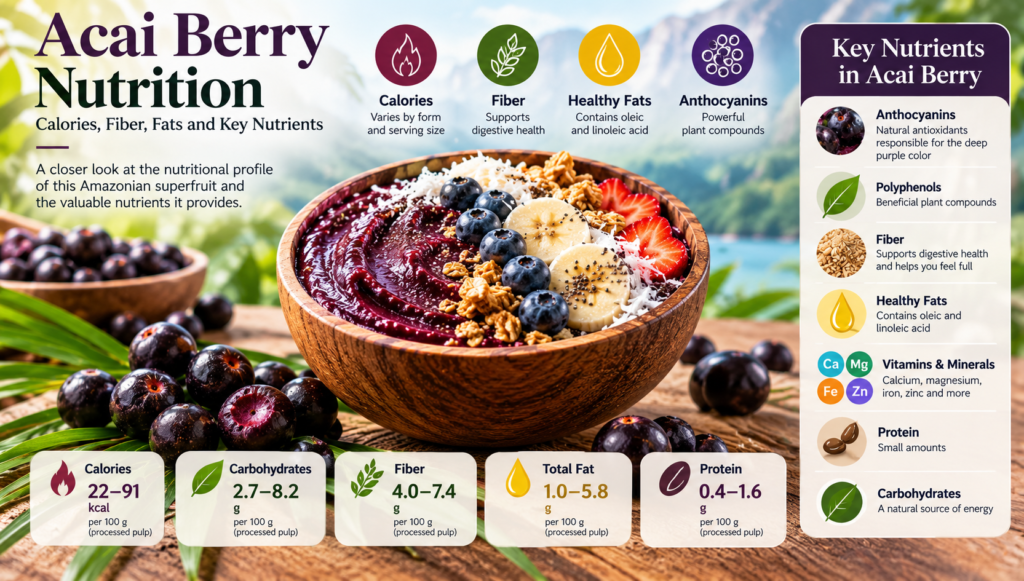
There is no single calorie number that applies to every acai product. Research on processed acai pulp has reported substantial variation in energy content, with differences related to the fruit variety, water content, processing method, and formulation. One recent review of Euterpe precatoria reported processed pulp values ranging from approximately 22 to 91 calories per 100 grams across analyzed samples.
This is an important distinction because commercial acai products are not necessarily equivalent to plain acai pulp.
An unsweetened acai product can have a very different nutritional profile from a smoothie bowl containing granola, honey, nut butter, fruit juice, or sweetened acai puree.
For that reason, if you are comparing products, the nutrition label is more useful than relying on a generic calorie figure found online.
Acai Berry Fiber: A Useful Part of Its Nutritional Profile
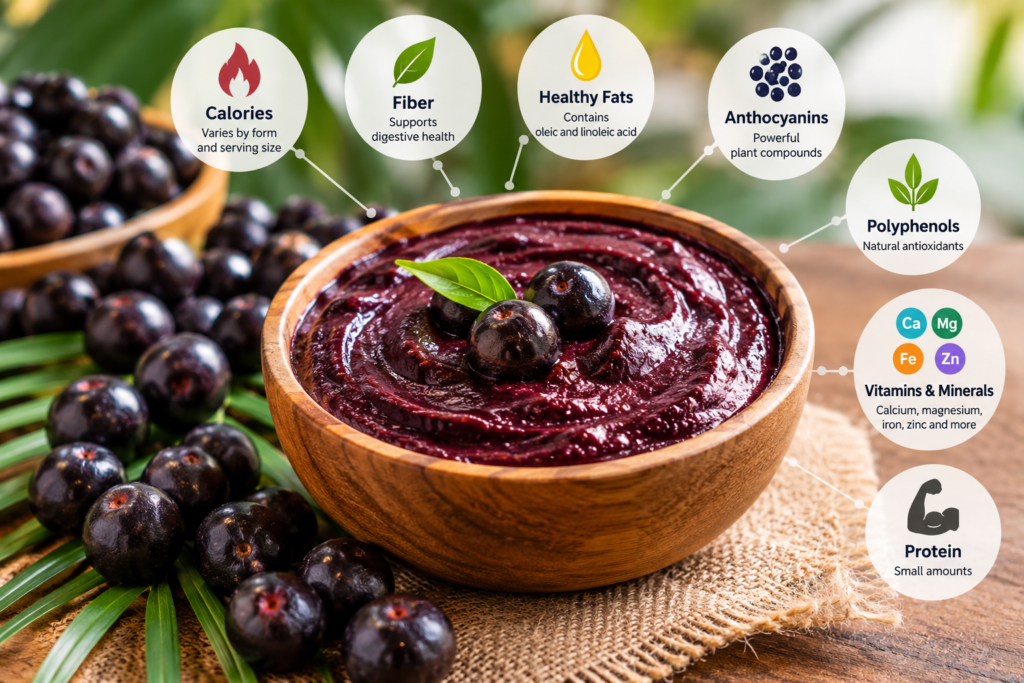
Acai berry fiber is another reason the fruit attracts attention.
Dietary fiber is naturally present in plant foods, and acai pulp can contribute meaningful amounts depending on how it has been processed. A recent systematic review reported approximately 7.4 grams of total fiber per 100 grams in analyzed processed pulp from Euterpe precatoria.
Fiber is important because it forms part of a balanced diet and is commonly associated with digestive health, satiety, and overall dietary quality.
However, it is worth remembering that not every acai product contains the same amount of fiber. Processing can change the composition, and some commercial products may contain relatively little actual acai.
If fiber is one of your priorities, check the nutrition facts panel rather than assuming that every product marketed as “acai” will provide the same amount.
Acai Berry Fats: An Unusual Feature of the Fruit
This is where acai differs from many berries.
When people think about berries, they usually expect a food that is primarily carbohydrate-based and naturally very low in fat. Acai is different because its pulp contains naturally occurring lipids.
Research examining acai pulp has identified oleic acid and linoleic acid among its principal fatty acids. In one review of Euterpe precatoria, oleic acid accounted for a substantial proportion of the fatty-acid profile, while linoleic acid was also present.
This does not mean that acai should be viewed as a high-fat food in every form. Once again, the actual nutritional values depend on the product and processing method.
The important point is simply that acai berry fats are a natural part of the fruit’s composition, making its nutritional profile different from that of many conventional berries.
What Nutrients Are in Acai Berry?
So, what nutrients are in acai berry?
The answer goes beyond vitamins and minerals.
Acai provides a combination of:
- Dietary fiber
- Naturally occurring fats
- Carbohydrates
- Small amounts of protein
- Minerals
- Polyphenols
- Anthocyanins
- Other plant compounds
The exact amounts vary between samples and products.
Research has identified minerals such as calcium, magnesium, manganese, iron, zinc, and copper in acai samples.
However, it is the fruit’s plant compounds that often receive the most scientific attention.
Anthocyanins
Anthocyanins are pigments belonging to the flavonoid family. They are responsible for much of the deep red, purple, and blue coloration found in many berries.
Acai contains several anthocyanins, with cyanidin-3-glucoside and cyanidin-3-rutinoside among the compounds most frequently identified in research.
These compounds are one reason acai has attracted so much interest from nutrition researchers.
Polyphenols
Acai also contains a range of polyphenolic compounds, including anthocyanins, proanthocyanidins, and other flavonoids and phenolic compounds.
Research has consistently shown that the composition can vary between samples and processing methods, which is another reason it is difficult to give one universal “antioxidant” or nutrient value for all acai products.
Acai Berry Nutritional Value Depends on How You Consume It
One of the biggest mistakes when discussing acai berry nutritional value is treating all acai products as though they are identical.
They are not.
Fresh or minimally processed pulp is different from freeze-dried powder. A powdered product may contain much more concentrated nutrients per gram simply because much of the water has been removed.
Likewise, an acai bowl from a restaurant can have a completely different nutritional profile from plain unsweetened acai pulp.
For example, toppings such as:
- Granola
- Honey
- Nut butter
- Coconut
- Banana
- Sweetened fruit puree
can significantly increase the total calories and sugar content of a finished bowl.
The acai itself may not be the main source of those additional calories.
Fresh Acai, Frozen Pulp, Powder, or Supplements?
Acai is available in several forms, and each has advantages depending on how you want to use it.
Frozen pulp is commonly used for smoothies and acai bowls and can provide a convenient way to include acai in food.
Acai powder is more concentrated because water has been removed during processing. It is often added to smoothies, yogurt, oatmeal, or other foods.
Acai supplements may contain acai in capsule, powder, or extract form. Their nutritional composition can differ significantly from that of whole or minimally processed fruit.
This is particularly important when comparing supplements. Research analyzing commercial acai supplements has found considerable variation in anthocyanin and polyphenol concentrations, and some products contained very little actual acai or had compositions affected by dilution or undeclared ingredients.
In other words, the word “acai” on the front of a package does not automatically tell you how much acai the product contains.
Is Acai Berry a Good Addition to a Balanced Diet?
For most people, the most sensible way to think about acai is as one component of an overall balanced diet rather than a miracle food.
Its combination of fiber, naturally occurring fats, and plant compounds makes it nutritionally interesting. But no single berry can replace a varied diet containing vegetables, fruits, whole grains, protein sources, and healthy fats.
It is also important to separate nutrition from marketing claims.
Scientific research has identified antioxidant and other biological activities associated with acai compounds, but laboratory findings do not automatically mean that eating acai will produce a specific medical outcome in humans. Current reviews emphasize that more high-quality human research is needed to fully understand the effects of acai consumption.
What Should You Look for on an Acai Product Label?
If you are buying acai pulp, powder, or a supplement, take a moment to read the label.
Look at:
- Serving size
- Calories per serving
- Dietary fiber
- Total carbohydrates
- Total fat
- Added sugars
- Percentage or amount of actual acai
- Other ingredients
- Recommended serving instructions
For sweetened acai products, added sugar can make a significant difference to the overall nutritional profile.
For supplements, it is also worth checking whether the manufacturer clearly identifies the ingredients and their quantities.
A transparent label makes it much easier to understand what you are actually buying.
The Bottom Line on Acai Berry Nutrition
Acai has an unusual nutritional profile compared with many familiar berries. It provides dietary fiber and naturally occurring fats, while also containing anthocyanins, polyphenols, minerals, and other plant compounds.
The most important thing to remember is that acai berry nutrition is not identical across all products. Fresh fruit, processed pulp, frozen products, powders, and supplements can have very different nutritional characteristics.
If you are interested in adding acai to your diet, choosing a minimally processed, clearly labeled product and paying attention to serving size is a sensible place to start.
Acai can be an interesting addition to a varied diet—but its value is best understood as part of the bigger nutritional picture, rather than as a shortcut to better health.